
INTRODUCTION
Running a trucking business today is no longer just about moving freight from point A to point B. Carriers face ongoing challenges such as delayed dispatch, rising fuel costs, communication gaps, compliance pressure, and slow payment cycles.
Many fleets still rely on spreadsheets and disconnected tools, which create inefficiencies, increase errors, and limit visibility. Without a centralized system, tracking trucks, managing drivers, and making timely decisions becomes difficult—often leading to higher empty miles and reduced efficiency.
Industry reports show that digital systems can improve operational efficiency by 20–30% while reducing manual workload. As competition grows, carriers are actively looking for smarter and more reliable ways to manage operations.
Understanding the carrier TMS software benefits is now essential. A modern transportation management system helps streamline workflows, improve visibility, and automate key processes within a single platform.
Fast Forward TMS is built to solve these challenges, backed by 18+ years of transportation technology expertise and trusted by 1,500+ companies worldwide. It helps carriers reduce inefficiencies, control costs, and gain complete operational visibility.
Key Takeaways
- Modern trucking operations can no longer rely on manual processes and disconnected tools
- A carrier TMS centralizes dispatch, tracking, billing, and compliance into one system
- Automation and real-time visibility help improve efficiency and reduce operational delays
- Lower administrative workload allows teams to focus on core business operations
- Strong driver and dispatcher coordination improves daily workflow and reduces errors
- Automated billing and faster payments lead to better cash flow and financial stability
- Real-time data insights help carriers control costs and improve profitability
- Scalable systems support fleet growth without adding operational complexity
- A centralized platform enables faster decision-making and better operational control
- Adopting a modern TMS is essential for staying competitive and future-ready
You may also like to Read: How Fast Forward TMS Stands Out as the Best Choice in Carrier TMS Software
What is Carrier TMS Software?
A Carrier TMS (Transportation Management System) is a cloud-based software that helps trucking companies manage dispatch, tracking, billing, driver communication, and compliance from a single platform.
Instead of relying on spreadsheets or disconnected tools, it centralizes operations, improves visibility, and streamlines daily workflows. This allows carriers to reduce manual work, minimize errors, and make faster, data-driven decisions.
For modern fleets, a TMS is not just a tool—it is essential for running efficient and scalable operations.
Who Should Use Carrier TMS Software?
Carrier TMS software is designed for trucking businesses that want to improve efficiency, reduce manual work, and gain better control over daily operations.
It is especially useful for small fleets managing dispatch manually, growing carriers facing delays and coordination issues, and mid-sized fleets handling multiple trucks, routes, and compliance requirements.
As operations expand, relying on spreadsheets and phone calls becomes difficult and error-prone. A carrier TMS helps streamline workflows, improve visibility, and simplify day-to-day management.
For any fleet looking to scale, reduce inefficiencies, and operate more efficiently, adopting a TMS becomes a practical necessity.
10 Key Reasons Carriers Are Switching to Fast Forward TMS
In today’s trucking industry, operational efficiency plays a critical role in profitability. Carriers that continue to rely on manual processes and disconnected tools often face delays, errors, and limited visibility across their operations.
Fast Forward TMS is built to address these challenges by simplifying workflows, improving coordination, and providing better control over daily operations. It helps carriers operate more efficiently and make faster, data-driven decisions.
Trusted by 1,500+ carriers, Fast Forward TMS has helped improve dispatch workflows, with 95% of users reporting smoother operations. It stands out by solving real-world challenges while delivering measurable improvements in efficiency, visibility, and profitability.
Here are the 10 key reasons carriers are making the switch:
Faster Dispatch and Efficient Load Management
One of the biggest challenges in trucking operations is delayed or inefficient dispatch. When dispatchers rely on phone calls, spreadsheets, or manual coordination, assigning loads becomes slow and error-prone.
Fast Forward TMS simplifies this process by enabling real-time load assignment and driver availability tracking. Dispatchers can instantly identify which driver is available, assign loads quickly, and manage multiple shipments from a centralized dashboard.
This leads to faster turnaround times, better load utilization, and increased daily productivity. As a result, fleets can handle more loads without increasing operational complexity.
Complete Real-Time Fleet Visibility
Lack of visibility is one of the most common operational problems for carriers. Without real-time data, it becomes difficult to track shipments, monitor driver activity, or respond quickly to delays.
Fast Forward TMS provides live GPS tracking and centralized dashboards that give carriers full visibility into their fleet. Dispatchers can see where every truck is, track delivery progress, and make informed decisions instantly.
This level of visibility reduces uncertainty, improves customer communication, and helps prevent costly delays or missed deliveries.
Reduced Administrative Workload
Manual processes such as paperwork, data entry, and reporting consume a significant amount of time and increase the risk of errors.
Fast Forward TMS automates routine operational tasks, including documentation, reporting, and workflow management. This reduces the administrative burden on teams and minimizes human errors.
By eliminating repetitive tasks, carriers can focus more on core operations like load planning and fleet optimization, ultimately improving overall efficiency.
Improved Driver Communication and Coordination
Effective communication between dispatchers and drivers is essential for smooth operations. However, relying on constant phone calls often leads to miscommunication, delays, and inefficiencies.
Fast Forward TMS includes a built-in driver mobile app that enables real-time communication, instant updates, and document sharing. Drivers can receive load details, upload documents, and stay connected without unnecessary back-and-forth calls.
This improves coordination, reduces confusion, and enhances the overall driver experience.
Faster Payments and Accurate Billing
Delayed payments and billing errors are common challenges in trucking, especially when invoicing is handled manually.
Fast Forward TMS automates invoicing and settlement processes, ensuring that invoices are generated quickly and accurately. This reduces disputes, eliminates errors, and speeds up payment cycles.
With faster and more reliable billing, carriers can improve cash flow and maintain financial stability.
Smarter Load Offer Negotiation
Negotiating load rates has traditionally been a time-consuming process involving multiple phone calls and back-and-forth communication.
Fast Forward TMS introduces a built-in load offer negotiation system that allows dispatchers and drivers to share offers, counteroffers, and finalize rates instantly.
This reduces delays, improves transparency, and ensures faster decision-making. It also builds better trust between drivers and dispatchers, leading to stronger working relationships.
Strong Compliance and Audit Readiness
Compliance requirements such as IFTA reporting, HOS tracking, and documentation management are becoming increasingly complex.
Managing these processes manually not only increases workload but also raises the risk of errors and penalties.
Fast Forward TMS automates compliance-related tasks, ensuring accurate reporting and proper documentation. This helps carriers stay audit-ready while reducing the risk of costly fines.
Better Cost Control and Profit Visibility
Without proper data, many carriers struggle to understand their true operating costs and profitability.
Fast Forward TMS provides real-time insights into key metrics such as cost per mile, fuel expenses, and profit margins. This allows carriers to make data-driven decisions and identify areas for cost optimization.
With better financial visibility, fleets can improve profitability and operate more efficiently.
Scalable and Flexible System for Growing Fleets
As fleets grow, managing operations becomes more complex. Many traditional systems fail to scale, forcing carriers to switch tools or deal with inefficiencies.
Fast Forward TMS is built with scalability in mind. Its flexible pricing model allows carriers to start small and expand as their business grows.
This ensures that the system continues to support operations without requiring major changes or additional investments.
Easy Adoption and Driver-Friendly Experience
One of the biggest challenges with new software is adoption. Complex systems often require long training periods and create resistance among users.
Fast Forward TMS is designed for simplicity and ease of use. Both dispatchers and drivers can quickly understand and start using the platform without extensive training.
This ensures faster onboarding, higher adoption rates, and quicker return on investment.
Fast Forward TMS vs Traditional Trucking Methods
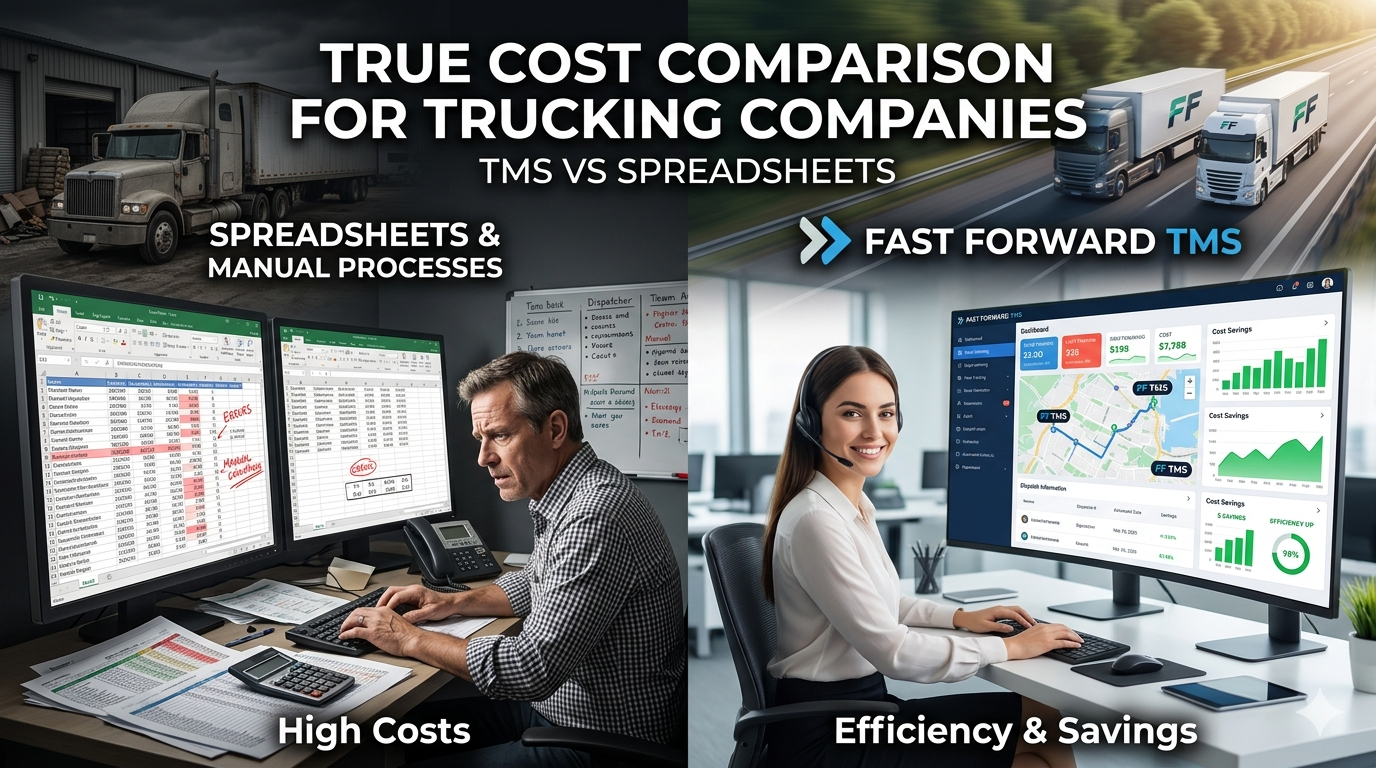
Many carriers still rely on spreadsheets, phone calls, and disconnected tools to manage daily operations. While these traditional methods may feel familiar, they often create inefficiencies that slow down growth and impact profitability.
Fast Forward TMS replaces these outdated processes with a modern, centralized system that connects dispatch, tracking, billing, and compliance into one streamlined workflow.
The difference between traditional methods and a modern TMS becomes clear when comparing key operational areas:
Comparison: Traditional Methods vs Fast Forward TMS
| Area | Traditional Methods | Fast Forward TMS |
| Dispatching | Manual scheduling, delays, confusion | Real-time dispatch with instant load assignment |
| Tracking | Limited visibility, frequent check calls | Live GPS tracking with full fleet visibility |
| Communication | Phone calls, missed updates | Real-time communication via mobile app |
| Billing | Manual invoicing, higher errors | Automated invoicing and faster payments |
| Compliance | Time-consuming, error-prone | Automated IFTA, HOS, and documentation |
| Data & Insights | Scattered data, no clarity | Centralized dashboard with real-time insights |
| Cost Control | Guesswork-based decisions | Accurate cost per mile and profit tracking |
What This Means for Carriers
Switching to Fast Forward TMS is not just about adopting new technology—it’s about transforming how operations are managed.
Instead of juggling multiple tools and manual processes, carriers gain a single platform that simplifies workflows, improves visibility, and reduces errors. This leads to faster decision-making, better resource utilization, and improved overall efficiency.
For growing fleets, this shift creates a strong operational foundation that supports scalability, profitability, and long-term success.
Conclusion
Running a trucking business today requires more than manual processes and disconnected tools. As operations grow, inefficiencies in dispatch, tracking, and billing can limit performance and profitability.
A modern TMS helps carriers streamline operations, improve visibility, and make faster, data-driven decisions. It brings everything into one system, reducing complexity and improving overall efficiency.
Fast Forward TMS is designed to support this shift, helping carriers simplify workflows, reduce operational challenges, and build a stronger foundation for growth.
For fleets aiming to stay competitive and scale efficiently, adopting the right system is a practical and forward-looking decision.
Ready to Simplify Your Trucking Operations?
Managing dispatch, tracking, billing, and compliance manually can slow down your operations and limit growth. As your fleet expands, these challenges become harder to manage.
Fast Forward TMS brings everything into one platform, helping you streamline workflows, reduce manual work, and gain full visibility across your operations.
With smarter dispatch, automated billing, and real-time tracking, your team can focus on growing the business instead of managing daily complexities.
👉 Get started today and experience a smarter way to manage your fleet.
frequently Asked Questions (FAQs)
What is carrier TMS software?
Carrier TMS (Transportation Management System) software is a cloud-based platform that helps trucking companies manage dispatch, tracking, billing, driver communication, and compliance from a single system.
Why do carriers switch to Fast Forward TMS?
Carriers switch to Fast Forward TMS to reduce manual work, improve dispatch efficiency, gain real-time visibility, and automate billing and compliance processes. It helps fleets operate more efficiently and improve overall profitability.
How does Fast Forward TMS improve dispatch operations?
Fast Forward TMS enables real-time load assignment, driver availability tracking, and centralized dispatch management. This reduces delays, minimizes confusion, and improves daily operational efficiency.
Is Fast Forward TMS suitable for small fleets?
Yes, Fast Forward TMS is designed for both small and mid-sized fleets. Its flexible pricing model allows smaller fleets to start easily and scale as their operations grow.
Does Fast Forward TMS help with compliance?
Yes, Fast Forward TMS automates compliance processes such as IFTA reporting, HOS tracking, and document management, helping carriers stay audit-ready while reducing manual effort.
How quickly can carriers start using Fast Forward TMS?
Fast Forward TMS is designed for easy onboarding. Most carriers can get started quickly without complex setup or long training, allowing them to see value in a short time.