
Introduction
TMS implementation is the process of deploying a transportation management system to streamline logistics operations, automate workflows, and improve overall efficiency. However, many carriers fail to achieve expected results due to poor planning, unclear goals, and slow adoption.
If you’re looking for a practical TMS implementation guide, your goal is likely to reduce operational costs, improve dispatch efficiency, and gain real-time visibility across your fleet. With the right strategy, businesses can implement a TMS smoothly without disrupting daily operations.
This transportation management system implementation guide provides a structured, step-by-step approach covering planning, vendor selection, execution, and optimization to ensure long-term success.
With 18+ years of experience and 1,500+ successful implementations, Nitin Shankar highlights that success comes from aligning technology with business workflows.
Many carriers aim to complete TMS implementation in 90 days, but achieving this requires proper planning and execution. This TMS implementation guide helps carriers implement faster while maintaining efficiency.
Key Takeaways: TMS Implementation
- A structured TMS implementation helps carriers reduce costs, automate operations, and improve visibility across their fleet.
- Following a clear TMS implementation guide ensures smoother adoption and better long-term results.
- Defining business goals and tracking the right metrics is essential for measuring success.
- Choosing the right system and involving the right team improves implementation speed and efficiency.
- Clean data, proper training, and continuous optimization are critical for avoiding common implementation challenges.
- Modern transportation management systems use automation and real-time analytics and insights to improve decision-making and scalability.
- Addressing challenges early and following best practices leads to a successful and scalable implementation.
Why TMS Implementation Fails
Many businesses struggle with TMS implementation not because of the software, but due to poor execution.
Common reasons include:
- Lack of clear goals and planning
- Poor data quality during migration
- Choosing a system that doesn’t fit operations
- Inadequate training and onboarding
- No continuous optimization after launch
Avoiding these mistakes ensures faster adoption, better efficiency, and long-term success.
Without proper execution, achieving TMS implementation in 90 days becomes difficult, leading to delays and poor adoption.
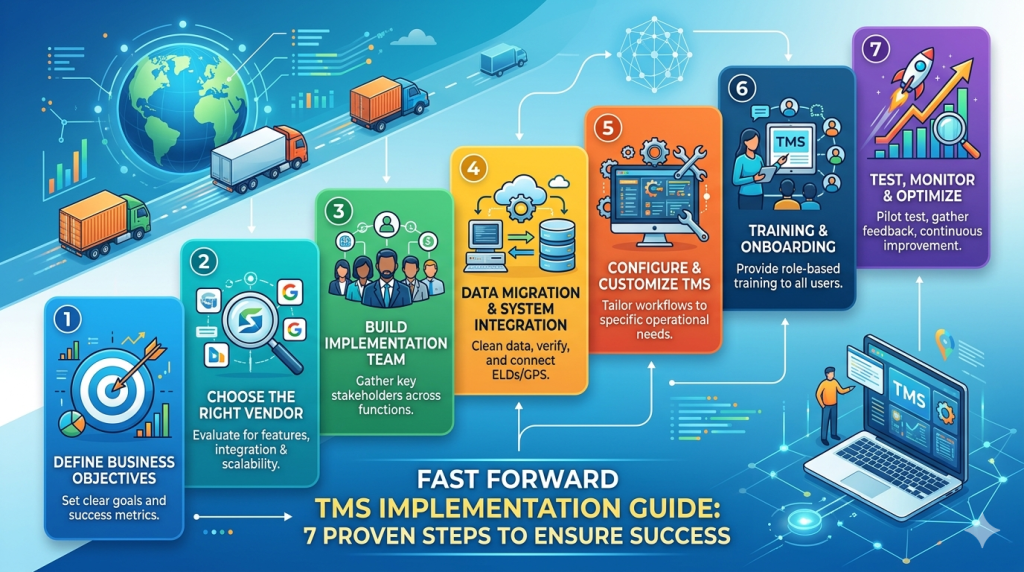
Step 1: Set Clear Business Objectives and Performance Metrics
If you want your TMS implementation to succeed, you first need to be clear about your business goals. Without a plan, you may end up with a system that looks powerful but doesn’t solve your real challenges.
Start by asking yourself what you want your TMS to achieve for your trucking business. Whether it’s reducing fuel costs, improving dispatch efficiency, or minimizing billing errors, clearly defined goals ensure your system delivers real value.
Some of the goals you can set:
- Lower fuel costs with fuel management and route optimization
- Improve dispatch efficiency through automation
- Reduce paperwork and billing errors with digital workflows
- Increase load acceptance rate and revenue
- Maintain compliance with industry regulations
Once goals are defined, connect them with measurable success metrics to track performance.
Key metrics you should track:
- Load acceptance rate
- Driver utilization percentage
- Cost per mile
- On-time delivery rate
- Operating cost per load
By linking your goals with clear metrics, you create a roadmap that guides your TMS implementation and helps measure ROI effectively.
Step 2: Choose the Right TMS Vendor
Not every TMS will be the right fit for your business. The success of your TMS implementation depends on selecting a system that matches your operational needs and supports future growth.
When evaluating options, focus on solutions that simplify workflows and improve efficiency rather than adding complexity.
What to look for:
- Scalability: Ability to grow with your fleet and business operations
- Ease of use: Intuitive dashboards and mobile-friendly interface for faster adoption
- Integration capabilities: Seamless connection with accounting software, ELDs, GPS, and load boards
- Automation features: Support for automated dispatch, billing, and reporting
- Customization: Flexibility to align workflows with your business processes
- Transparent pricing: Clear cost structure without hidden charges
The right system also helps reduce transportation management systems implementation time and improves overall performance.
You may also like to read: Best Carrier TMS Software for Trucking : How toChoose the Right Solution
Step 3: Build an Implementation Team
Even the best system cannot succeed without the right people involved. A strong team is essential for a smooth TMS implementation and successful adoption.
Include key stakeholders who will use and manage the system in daily operations. Their involvement helps identify practical challenges early and ensures better alignment with business workflows.
Who should be on your team?
- Dispatchers: Manage load assignments and daily operations
- IT team: Handle integrations with ELDs, GPS, and accounting systems
- Finance team: Ensure billing, payroll, and reporting accuracy
- Compliance team: Support regulatory and safety requirements
- Drivers: Provide feedback on mobile apps and real-world usage
A cross-functional team improves communication, reduces resistance to change, and ensures your TMS implementation is successful.
Step 4: Data Migration & System Integration
Once you’ve selected your system, the next step in TMS implementation is ensuring your data is accurate and your systems are properly connected. Poor data quality or weak integration can lead to delays and operational issues.
Before migration, review and clean your existing data to avoid errors in the new system.
Focus on:
- Removing duplicate customer and driver records
- Standardizing data formats for addresses, invoices, and load details
- Verifying contracts, rates, and compliance documents
Start with a phased migration by testing a small dataset before full deployment. This helps identify issues early and ensures smoother implementation.
Seamless integration with tools like ELDs, GPS tracking, and accounting systems is critical for a successful transportation management system implementation.
Step 5: Configure & Customize the TMS
After data migration and integration, the next step in TMS implementation is configuring the system to match your business workflows. A properly configured system improves efficiency and reduces manual effort.
Your TMS should support your operations instead of forcing process changes.
Tailor workflows to your business:
- Set up dispatch rules for truck load management and load assignment
- Automate tasks such as invoicing and driver updates
- Create approval workflows for rates and payments
Customize dashboards for each role:
- Dispatchers track loads and vehicle status
- Finance teams monitor billing and reports
- Drivers access load details and communication tools
Use automation features:
- AI-based load assignment for better planning
- Route optimization to reduce fuel costs
- Automated compliance checks
Proper configuration ensures your TMS implementation delivers accuracy, speed, and operational control.
Step 6: Training & Easy Onboarding
Even the most advanced system will fail without proper adoption. Training is a critical part of any TMS implementation to ensure your team can use the system effectively.
A simple and structured onboarding process helps reduce resistance and improves user confidence.
Best practices for training:
- Provide role-based training for dispatchers, drivers, and admins
- Use simple resources such as video tutorials and guides
- Allow hands-on practice with real scenarios
- Offer ongoing support for questions and issues
Effective training ensures faster adoption, fewer errors, and better performance from your TMS implementation.
Step 7: Test, Monitor & Optimize
Once your system is ready, the final stage of TMS implementation is testing, monitoring, and continuous improvement. A structured rollout helps identify issues early and ensures stable performance.
Start with a pilot rollout before full deployment to validate workflows and system accuracy.
Focus on:
- Testing real-world scenarios such as dispatching, tracking, and billing
- Monitoring system performance and identifying gaps
- Continuously improving workflows based on feedback
Key metrics to track:
- Load profitability
- Route efficiency
- Driver utilization
- Billing accuracy
Ongoing monitoring and optimization ensure your TMS implementation delivers consistent results and long-term efficiency.
What Are the Key Challenges and Best Practices in TMS Implementation and Adoption?
Even with a clear plan, TMS implementation can face challenges during execution. Identifying these issues early helps improve adoption and reduce delays.
Common challenges:
- Resistance to change: Teams may hesitate to adopt new systems
- Data migration errors: Inaccurate or incomplete data affects performance
- Integration issues: Difficulty connecting with existing tools
- Underestimating costs: Hidden expenses in setup and training
- Lack of optimization: No improvements after system launch
Best practices:
- Define clear goals before implementation
- Clean and validate data before migration
- Choose a scalable and easy-to-use system
- Provide proper training and onboarding
- Continuously monitor and optimize performance
Addressing these challenges and following best practices ensures smoother adoption and long-term success of your TMS implementation.
Future of TMS Implementation
The future of TMS implementation is shifting from basic logistics management to intelligent, data-driven decision-making. As operations become more complex and customer expectations rise, carriers need systems that not only manage workflows but actively improve performance.
Modern transportation management systems are evolving to combine automation, real-time data, and predictive insights. This allows businesses to operate more efficiently, reduce costs, and make faster, more informed decisions.
What’s shaping the future of TMS implementation:
- AI-driven decision making:
Advanced TMS platforms use AI to predict delays, recommend optimal routes, and automate dispatch decisions. This reduces manual effort and helps carriers respond quickly to operational changes.
- Deeper integrations across systems:
Modern systems connect seamlessly with telematics, ELDs, fuel monitoring, maintenance tools, and analytics platforms. This creates a unified view of operations and improves overall control.
- Cloud-based and mobile-first access:
Cloud technology enables real-time access to operations from anywhere. Dispatchers, managers, and drivers can stay connected through mobile devices, improving communication and responsiveness.
- Enhanced data security and compliance:
With increasing cyber risks, TMS platforms are adopting stronger security measures such as encryption and compliance frameworks. This ensures sensitive operational and financial data remains protected.
- Scalable and modular systems:
Businesses can start with essential features and expand as they grow. Modular systems allow carriers to add automation, analytics, and integrations without disrupting existing workflows.
- Focus on sustainability and efficiency:
Modern TMS solutions help reduce fuel consumption, optimize routes, and minimize empty miles. This not only lowers costs but also supports environmental goals and regulatory requirements.
As these advancements continue, businesses that adopt modern solutions will gain a competitive advantage. A forward-looking TMS implementation ensures your operations remain efficient, scalable, and ready for future challenges.
Why Fast Forward TMS is Your Partner for a Smooth TMS Implementation
Implementing a new TMS Sysytem can feel complex, but the right partner makes the process faster and more efficient. Fast Forward TMS is built specifically for carriers, focusing on real-world workflows, ease of use, and quick adoption.
With 18+ years of experience and 1,500+ successful implementations, the platform is designed to solve common challenges such as data migration issues, slow onboarding, and system complexity.
What makes Fast Forward TMS different:
- Carrier-focused design: Built specifically for trucking operations, not generic logistics use cases
- Easy onboarding: Intuitive interface and mobile-first approach reduce training time
- Seamless integrations: Connect with ELDs, GPS, accounting tools, and load boards
- Automation-driven workflows: Reduce manual work in dispatch, billing, and compliance
- Scalable platform: Supports growth from small fleets to large operations
- Dedicated support: Guidance at every stage of your TMS implementation
By combining industry expertise with practical technology, Fast Forward TMS ensures a smoother rollout, faster adoption, and better long-term performance.
Conclusion
A successful TMS implementation is not just about adopting new software—it’s about improving how your logistics operations work every day. From setting clear goals to choosing the right system and continuously optimizing performance, each step plays a critical role in long-term success.
By following a structured TMS implementation guide, carriers can reduce costs, improve efficiency, and gain better control over their operations. The key is to focus on practical execution, team adoption, and ongoing improvements rather than just system setup.
With the right approach, a transportation management system becomes more than a tool—it becomes a foundation for scalable growth, better decision-making, and consistent operational performance.
Ready to Simplify Your TMS Implementation?
If you’re planning a TMS implementation or looking to improve your current system, choosing the right platform can make all the difference.
Fast Forward TMS helps carriers streamline operations, automate workflows, and achieve faster results with a system built for real-world logistics.
👉 Get started today and see how you can simplify your operations and improve efficiency.
Frequently Asked Questions about TMS Implementation
What is TMS implementation?
TMS implementation is the process of setting up and integrating a transportation management system to manage dispatch, tracking, billing, and logistics operations. It helps carriers automate workflows, improve efficiency, and gain real-time visibility.
Why is TMS implementation important for carriers ?
A well-planned TMS implementation helps carriers reduce operational costs, improve dispatch efficiency, minimize errors, and ensure compliance. It also supports scalability as business operations grow.
What are the common challenges in TMS implementation?
Common challenges include resistance to change, poor data quality, integration issues, underestimating costs, and lack of ongoing optimization. These can be managed with proper planning, clean data, and team training.
How long does TMS implementation take?
The timeline for TMS implementation depends on fleet size and complexity. In most cases, it can take a few weeks to a few months with proper planning and execution.
How do I measure the success of TMS implementation?
Success can be measured using key performance indicators such as load acceptance rate, driver utilization, cost per mile, on-time delivery, and billing accuracy. Improvements in these metrics indicate effective implementation.
How to implement a transportation management system faster?
To reduce implementation time, define clear goals, choose the right vendor, clean your data before migration, and provide proper training. A structured approach ensures faster adoption and smoother deployment.
How to complete TMS implementation in 90 days?
To achieve TMS implementation in 90 days, businesses should define clear goals, choose the right vendor, clean data before migration, and ensure proper team training. A structured approach helps reduce delays and improve adoption.