
Introduction
Imagine a truck that predicts its own maintenance needs, helps the driver avoid traffic before it builds up, and even negotiates loads in real time. That’s not science fiction—it’s the reality of AI in the trucking industry today.
Just a few years ago, GPS and electronic logs felt like breakthrough tech. Today, AI in trucking is reshaping the trucking industry by streamlining operations, boosting safety, and cutting costs. From dispatch to driver payments, AI is helping every carrier move smarter, faster, and more efficiently than ever before with the support of a modern transport management system.
Through years of hands-on work developing AI solutions for logistics, I’ve seen firsthand how AI in the trucking industry is transforming the industry. This comprehensive guide details five powerful ways these innovations are becoming essential for staying competitive.
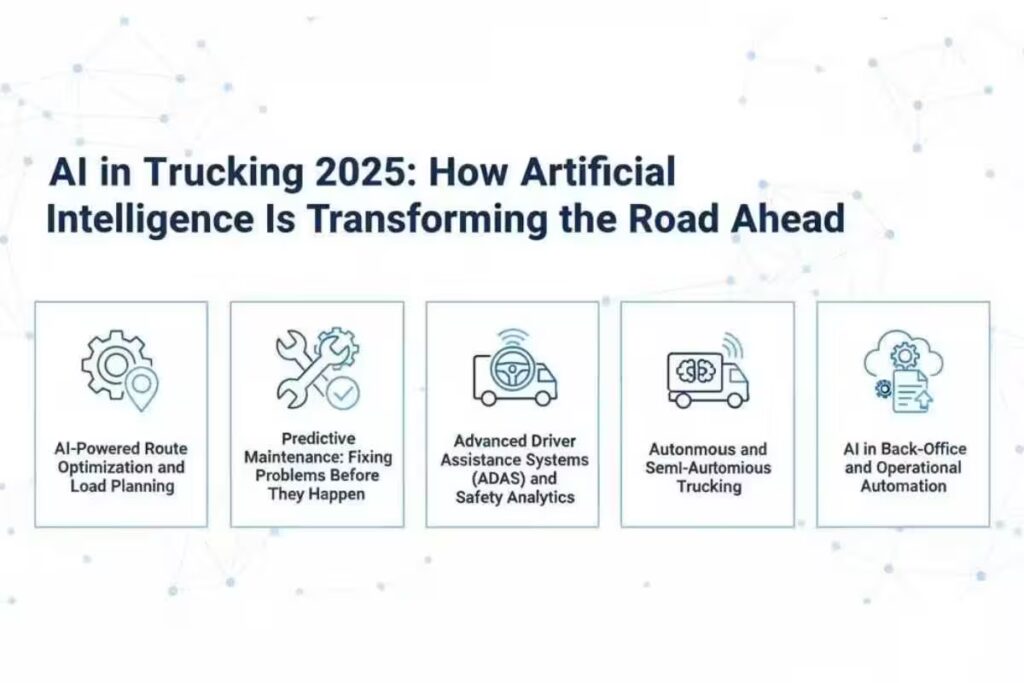
AI in Trucking 2025: How Artificial Intelligence Is Transforming the Road Ahead
Artificial Intelligence isn’t a futuristic dream anymore—it’s already reshaping how trucks move, fleets operate, and carriers make decisions. In 2025, AI in the trucking industry has become the backbone of smarter, safer, and more profitable operations across the U.S.
From predictive maintenance to intelligent routing and driver-assist systems, AI trucking technology is redefining efficiency and reliability on every mile of the highway. Let’s explore how these innovations are transforming the future of trucking and setting a new standard for intelligent logistics.
AI-Powered Route Optimization and Load Planning
Time and fuel—two things every carrier fights to save. AI-powered routing tools are changing that fight completely. These systems process live traffic, weather, and road condition data to instantly map the most efficient routes. They even factor in load weight, driver hours, and delivery windows to minimize delays and fuel waste—making trucking operations more cost-effective and eco-friendly.
Route Optimization with Real-Time Intelligence
AI-driven systems continuously analyze traffic patterns, weather conditions, rest stop availability, and driver behavior to adjust routes dynamically. Fleet managers receive real-time insights to avoid congestion and improve overall trip efficiency. This is how AI trucking solutions are powering the next generation of smarter, more efficient fleets.
Load Planning and Fuel Efficiency
By combining route intelligence with historical trip data, AI in trucking helps dispatchers balance schedules, optimize driver capacity, and cut idle miles. These AI-driven systems refine trucking operations, improving cost-per-mile efficiency and delivery consistency.
According to McKinsey (2023), connected-fleet analytics can reduce fuel consumption by up to 8%, showing how technology in trucking is driving measurable gains in profitability and sustainability.
Read More – 5 Ways Load Offer Negotiation Saves Carriers Time and Money
Predictive Maintenance: Fixing Problems Before They Happen
Breakdowns don’t just delay deliveries—they drain profits. AI trucking technology now enables fleets to detect trouble long before it happens.
Sensors collect real-time data on a truck’s engine, brakes, oil pressure, and vibration patterns. AI models analyze this data to detect anomalies that may indicate wear or component failure.
Engine Health and Component Diagnostics
Machine learning algorithms compare sensor readings across thousands of previous trips, detecting deviations within seconds. Early detection allows maintenance teams to repair components before they fail on the road, improving uptime and vehicle reliability.
Data-Driven Maintenance Scheduling
Instead of relying on fixed service intervals, AI builds maintenance schedules based on real-time vehicle data and usage patterns. Fleet operators report that predictive analytics helps reduce unexpected breakdowns and improve vehicle reliability—making AI in trucking operations a core driver of uptime and long-term cost efficiency.
Advanced Driver Assistance Systems (ADAS) and Safety Analytics
Safety remains at the heart of every trucking industry operation. AI enhances that safety through Advanced Driver Assistance Systems (ADAS)—tools that monitor surroundings, predict risks, and guide drivers in real time. Features like lane-keeping assist, adaptive cruise control, and fatigue detection make long-haul driving significantly safer for both drivers and fleets.
Driver Behavior and Fatigue Monitoring
AI-powered dashcams detect risky driving behaviors such as distraction, tailgating, or harsh braking. Real-time alerts help drivers correct behavior instantly, fostering a culture of safety and accountability rather than penalty.
Explore More – Driver Mobile App
Collision Avoidance and Road Risk Analytics
AI-driven safety systems in trucking continuously analyze braking patterns, lane drift, and blind-spot data to predict and prevent collisions. According to the NHTSA (2024), vehicles with automatic emergency braking show up to 49% fewer front-to-rear crashes, highlighting how AI in trucking enhances on-road safety. These intelligent systems help fleet managers identify high-risk routes and improve driver performance—making every mile smarter and safer.
Autonomous and Semi-Autonomous Trucking
The future of trucking is steering toward autonomy. While fully driverless trucks are still in testing, semi-autonomous features are already transforming logistics operations. Trucks equipped with adaptive cruise control, lane-centering, and automated braking maintain precise control across long routes, reducing fatigue and fuel consumption.
Semi-Autonomous Operations in Practice
Freight networks worldwide are testing semi-autonomous trucks that handle most highway navigation while drivers manage city routes. This balanced use of AI in trucking improves safety, reduces fatigue, and boosts efficiency—showing how automation and human control can work together for smarter, safer long-haul transport.
The Future of Freight Mobility
AI-driven technology is reshaping freight mobility by making trucking operations smarter, safer, and more connected. From predictive analytics to semi-autonomous systems, carriers are adopting automation to improve route planning, reduce delays, and support sustainable transport. This shift toward intelligent freight systems marks the next phase of innovation in the global trucking industry.
AI in Back-Office and Operational Automation
Beyond the road, AI is transforming the heart of fleet management—operations and documentation.
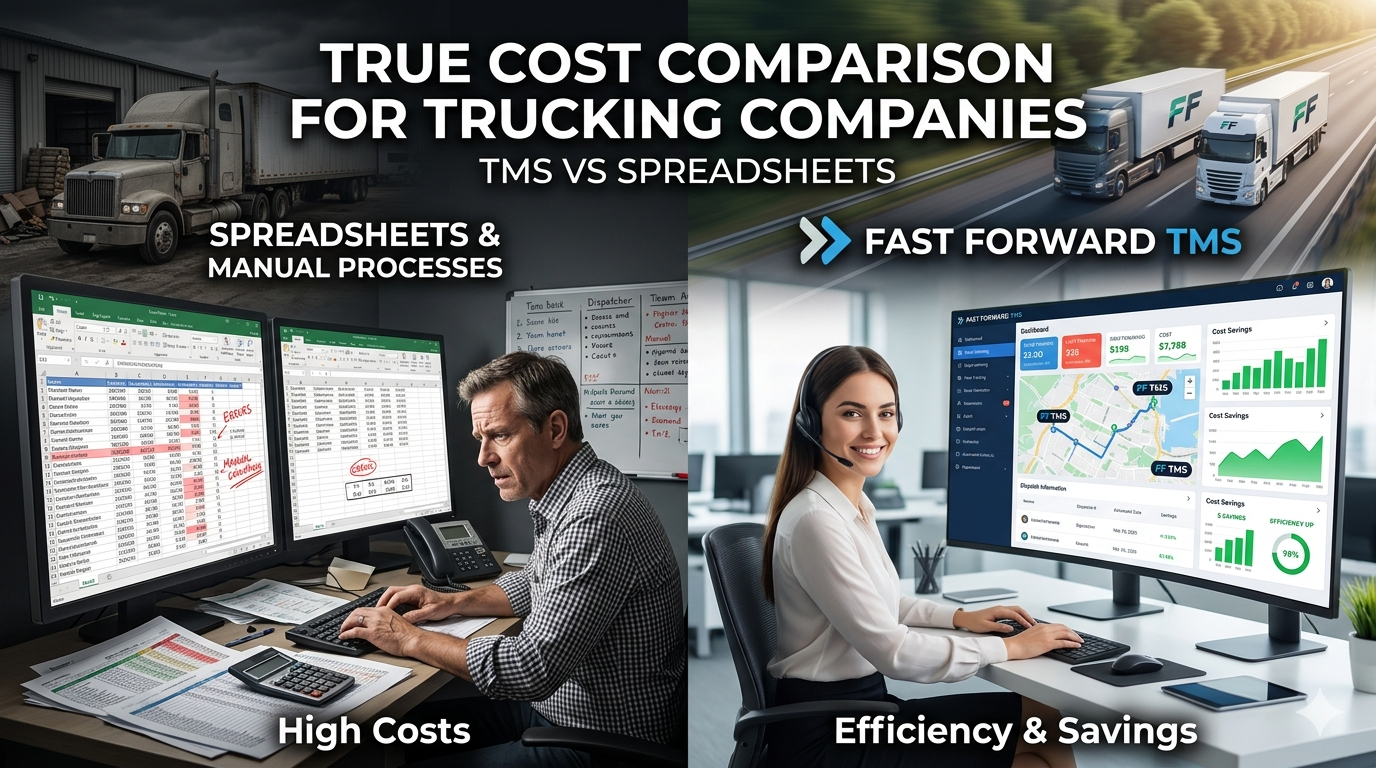
Carriers handle thousands of invoices, bills of lading, rate confirmations, and compliance records. AI now automates these repetitive tasks, saving hours of manual effort each week and minimizing human error. The future of the trucking industry runs on automation — not spreadsheets.
See our latest insights on LinkedIn to discover how carriers are replacing manual workflows with smarter TMS solutions.
Smart Document Processing and Compliance
AI verifies load documents, extracts data from digital images, and flags missing permits or expiring records—keeping fleets audit-ready at all times. This is where innovations like Five TMS AI tools are setting new benchmarks for automation and accuracy in the trucking industry.
Also Read – Top 5 Ways a TMS Software Reduces Manual Work for Dispatchers
AI Assistants for Scheduling and Analytics
Dispatchers use conversational AI to plan loads, optimize schedules, and communicate directly with drivers. Real-time analytics software reveal trends in cost-per-mile, utilization, and compliance health—helping managers make data-driven decisions faster.
Professionals implementing AI in trucking operations consistently report measurable ROI—reduced admin costs, faster billing cycles, and better operational control.
And while some wonder will AI replace truck dispatchers, the truth is simpler: AI doesn’t replace human intelligence—it amplifies it, paving the way for smarter, more efficient fleet operations.
Key Benefits of AI in the Trucking Industry: Safety, Efficiency, and Sustainability
AI is redefining the trucking industry, helping carriers move smarter, safer, and more sustainably.
From predictive analytics to automation, AI in trucking enables fleets to operate with real-time intelligence and lower costs—turning traditional operations into data-driven systems of efficiency.
Safety: Smarter Roads, Safer Fleets
AI-driven safety tools now detect fatigue, distractions, and unsafe driving patterns in real time. Smart cameras and sensors powered by AI trucking technology alert drivers before accidents happen, creating safer roads and lower insurance risks. Fleet managers use this data to coach drivers and maintain a culture of safety across every mile.
Efficiency: Every Mile Optimized
In today’s trucking operations, efficiency equals profitability. AI-driven route planning, load matching, and automated dispatching reduce fuel waste, empty miles, and idle time. Through trucking industry automation, dispatchers gain instant insights to optimize trips—keeping trucks moving and margins growing.
Sustainability: Driving the Future of Trucking
The future of trucking depends on sustainability—and AI makes it practical. By optimizing routes and reducing unnecessary miles, fleets cut emissions while saving fuel. Intelligent load planning ensures every truck runs fuller and cleaner, aligning operational growth with environmental responsibility.
Read More – Top 10 Benefits of Using TMS for Carriers in 2025
Challenges of Adopting AI in the Trucking Industry
While AI in trucking delivers major gains, its adoption journey isn’t without obstacles. Understanding these early helps carriers plan better and ensure smoother digital transformation.
- Workforce Shift: Integrating AI in trucking operations changes how dispatchers, drivers, and fleet managers work. Companies must invest in training and new tech-oriented roles, such as Logistics Data Analyst or AI Fleet Specialist, to bridge the human–machine gap.
- Cybersecurity: As more data moves through cloud-based TMS software, security becomes critical. Using a SOC 2 Type 2 compliant trucking management system helps protect sensitive fleet and driver information from cyber threats.
- Tech Gaps: Some fleets, especially small or regional carriers, may lack connected trucks or strong telematics infrastructure. A phased approach to AI adoption—starting with route optimization or predictive maintenance—ensures smoother scaling.
- Regulations: Transport laws around AI, driver monitoring, and autonomous systems are evolving. Fleets need adaptive systems that stay compliant with changing DOT and ELD regulations to avoid disruptions.
Read More – FMCSA Eliminates MC Numbers by October 2025: What Carriers Need to Know
Why Fast Forward TMS Leads AI-Driven Innovation in the Trucking Industry
Fast Forward TMS is built for carriers that want smarter, faster, and more efficient operations. The platform combines practical logistics know-how with secure, cloud-first engineering to solve real fleet problems.
The platform’s development draws on deep logistics and operational expertise gained from years of working directly with carriers and fleet operators. Every feature — from Load Offer Negotiation to Driver Availability with Smart Geo-Location Matching — was built around real-world dispatch challenges, ensuring practical tools that reduce delays and improve load acceptance.
Security and trust are central. The platform runs in a SOC 2 Type 2–aligned environment and follows strong data-protection practices, so carriers can automate sensitive workflows with confidence. Fast Forward TMS has been field-tested by hundreds of fleets: more than 1,500 companies use the system, and most customers report noticeably smoother dispatch workflows and measurable time savings per load.
Built for fleets of every size, the platform emphasizes rapid implementation, an intuitive dashboard, and responsive support. Practical automation — from ePOD and payroll automation to AI analytics — helps carriers cut administrative work and focus on profitable operations. To lower the barrier for adoption, Fast Forward TMS includes a cost-effective plan with the first user free.
Read More – How Fast Forward TMS Stands Out as the Best Choice in Carrier TMS Software
Conclusion
AI in the trucking industry has moved beyond hype—it’s driving measurable change across fleet operations. When paired with a Transportation Management System (TMS), these AI tools help carriers scale globally with greater efficiency and compliance. From intelligent dispatching and predictive maintenance to real-time fraud detection and automated workflows, AI is solving long-standing challenges with speed and precision. When embedded within a modern carrier TMS software, these innovations not only boost efficiency and safety but also position carriers to scale confidently in a rapidly evolving logistics landscape. Embracing an AI-driven trucking management system is no longer a competitive edge—it’s a foundational necessity.
Ready to see how Fast Forward TMS’s AI-powered tools can help your fleet reduce costs, boost safety, and drive profitability?
FAQ
In what ways is AI reshaping the operations and efficiency of the modern trucking industry?
AI in the trucking industry improves operations by streamlining dispatch, predicting maintenance, enhancing safety, detecting fraud, and automating back-office tasks. These advancements help carriers cut costs, boost efficiency, and remain competitive.
Will AI take over the trucking industry?
No, AI will not fully replace human drivers. Instead, it automates critical tasks like dispatch, routing, and safety monitoring. AI complements the workforce, increasing productivity while allowing humans to focus on decision-making.
What is AI-powered dispatching in trucking?
AI-powered dispatching uses machine learning to assign loads to the best drivers based on real-time availability, location, equipment type, and past performance. This reduces idle time, minimizes empty miles, and increases fleet efficiency.
Can AI help reduce truck maintenance costs?
Yes, AI lowers maintenance costs by using predictive analytics to monitor engine and sensor data in real time. This detects potential issues early, enabling proactive repairs, reducing breakdowns, and saving money.
What role does AI play in safety and compliance in the trucking industry?
AI enhances safety and compliance by analyzing driver behavior through tools like dashcams and electronic logging devices (ELDs). It identifies risky driving patterns, issues real-time alerts, and automates compliance tasks such as document tracking and renewal reminders. This reduces accident risks, prevents violations, and ensures fleets remain DOT-compliant.