
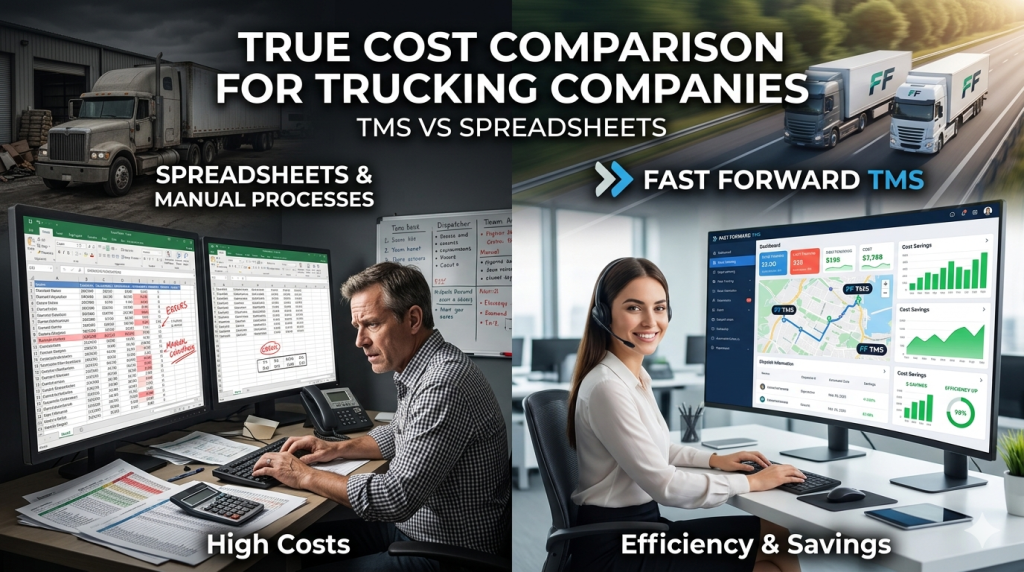
Fast Forward TMS vs Spreadsheets: True Cost Comparison for Trucking Companies
Introduction Running a trucking business today depends on how efficiently dispatch, tracking, billing, and compliance are managed. Yet many carriers still rely on spreadsheets for these critical operations. When comparing TMS vs spreadsheets, the difference is not just about cost—it’s about operational efficiency. Spreadsheets may seem affordable upfront, but as operations grow, manual workflows increase time, errors, and inefficiencies. Manual data entry, disconnected files, and repeated updates slow down processes. This leads to higher workload, delayed invoicing, limited visibility, and inconsistent cash flow. In contrast, carrier TMS software connects dispatch, tracking, billing, and compliance into one system. It reduces manual effort, improves accuracy, and provides real-time visibility across operations. In fact, at Fast Forward TMS, 95% of carriers report smoother dispatch workflows after adopting the platform, highlighting the real-world impact of automation and connected systems. This guide is written by Nitin Shankar, a logistics technology expert with 18+ years of experience, ensuring practical insights based on real trucking operations and system implementation. The real difference between a TMS and spreadsheets lies in scalability and efficiency. While spreadsheets create hidden operational costs, a TMS helps carriers improve cash flow, reduce errors, and scale operations without increasing workload. Key Takeaways: TMS vs Spreadsheets A TMS is more efficient and scalable than spreadsheets for trucking operations. While spreadsheets appear low-cost, they create hidden operational costs through manual work, errors, and delayed billing. A modern carrier TMS software reduces inefficiencies, improves cash flow, and supports business growth. Quick Summary Spreadsheets = low upfront cost, high hidden costManual workflows increase time, errors, and operational complexity.TMS = predictable cost, higher efficiencyAutomates dispatch, tracking, billing, and compliance in one system.Billing and cash flow improve with TMSFaster invoicing reduces delays and improves revenue consistency.Operational visibility is limited in spreadsheetsA TMS provides real-time tracking and centralized data.Scalability is the biggest differenceSpreadsheets become harder to manage as operations grow, while a TMS supports growth without extra workload.Error reduction directly impacts profitabilityAutomated workflows minimize manual mistakes and revenue leakage. What Costs Are We Comparing in TMS vs Spreadsheets? When comparing TMS vs spreadsheets, focusing only on software pricing gives a misleading view. In trucking operations, cost is not just what you pay upfront—it’s how your system affects efficiency, revenue, and scalability over time.Spreadsheets appear inexpensive because they have little to no upfront cost. However, their real impact is operational. Manual processes introduce time delays, errors, and inefficiencies that gradually increase the total cost of running a trucking business.A modern carrier TMS software, on the other hand, introduces a predictable subscription cost but reduces hidden operational expenses through automation and connected workflows. Key Cost Factors in TMS vs Spreadsheets You may also like to Read: TMS Software vs Traditional Methods – A Complete Comparison for Fleet Management in 2025 Where Spreadsheets Actually Cost You in Trucking Operations At first glance, spreadsheets appear cost-effective because they require little to no upfront investment. However, in a TMS vs spreadsheets comparison, the real cost is not eliminated—it is distributed across daily operations through time loss, errors, and inefficiencies.As trucking operations grow, these hidden costs become more visible and begin to impact productivity, accuracy, and cash flow. Time Loss from Manual Workflows Time is the first and most immediate cost. Managing loads through spreadsheets requires continuous manual effort—data is entered repeatedly, updated across multiple files, and coordinated outside the system.As volume increases, this creates a growing administrative burden where teams spend more time managing data than executing operations. Errors That Disrupt Operations Spreadsheets rely entirely on manual input, making data accuracy difficult to maintain. Missing entries, duplicate records, broken formulas, and outdated information often lead to billing errors and operational confusion.These errors directly impact efficiency and increase the risk of financial loss. Revenue Leakage and Billing Delays Without a connected system, ensuring accurate and timely billing becomes challenging. Missed invoices, delayed billing cycles, and incomplete charges reduce revenue visibility and slow down cash flow.Over time, these gaps create significant financial impact. Limited Visibility and Slow Decision-Making Spreadsheets do not provide real-time tracking or centralized insights. Teams rely on manual updates and scattered information, making it harder to monitor performance or respond quickly to operational issues.This lack of visibility slows decision-making and reduces overall control. Compounding Inefficiencies as You Scale As more loads, drivers, and transactions are added, spreadsheet-based workflows become increasingly complex. Instead of improving efficiency, growth leads to more coordination, more manual effort, and higher operational risk.In a TMS vs spreadsheets scenario, this is where spreadsheets shift from a simple tool to a limitation on scalability. You may also like to Read: Top 5 Ways a TMS Software Reduces Manual Work for Dispatchers How Fast Forward TMS Reduces Operational Costs In a TMS vs spreadsheets comparison, the biggest advantage of a modern system is automation. Unlike spreadsheets, carrier TMS software like Fast Forward TMS manages trucking operations through connected workflows, reducing the operational cost created by manual processes.By bringing dispatch, tracking, billing, and compliance into one system, it eliminates the need for repetitive coordination and disconnected tools. Faster Operations with Less Manual Work Time efficiency improves immediately. Tasks like data entry, load updates, and coordination no longer require repeated manual effort.Information is entered once and automatically flows across workflows, reducing duplication and administrative workload. This allows teams to focus on operations instead of managing data. Improved Accuracy and Fewer Errors Structured workflows and system-driven processes improve data accuracy.Duplicate entries, missing records, and billing errors are significantly reduced, resulting in smoother operations and fewer disruptions. Faster Billing and Stronger Cash Flow Billing becomes faster and more reliable because it is directly connected to operational data.Invoices can be generated immediately after load completion, while integrated driver payroll ensures timely payments. This reduces delays and improves overall cash flow consistency. Scalable Operations Without Extra Workload As operations grow, the system handles increased complexity without adding manual effort.More loads, drivers, and transactions can be managed within the same workflow. Integrated truck tracking software provides real-time visibility, helping teams make faster and more informed decisions. Simplified Compliance and Record
Fast Forward TMS vs Spreadsheets: True Cost Comparison for Trucking Companies Read More »