March 2026

Fast Forward TMS Rolls Out Easter Special Offer for Trucking Companies 

Fast Forward TMS Rolls Out Easter Special Offer for Trucking Companies 

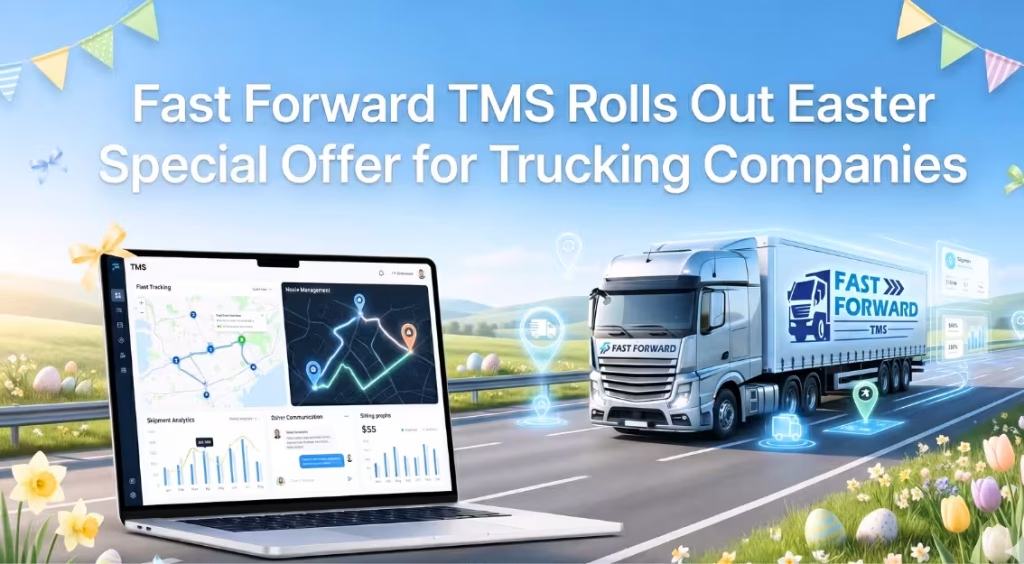
 A new Easter initiative from Fast Forward TMS is highlighting how trucking companies can adopt more efficient and technology-driven approaches to fleet management amid increasing operational challenges.  The transportation industry continues to face rising operational costs, fragmented workflows, delayed dispatch coordination, and limited real-time visibility. These challenges have led many carriers to explore centralized and automated systems that can improve efficiency and decision-making.  Fast Forward TMS, a cloud-based transportation management system designed for carriers, provides tools for dispatch management, real-time fleet tracking, driver communication, and automated billing and settlements. By consolidating these functions into a single platform, the system helps reduce manual coordination and improve operational control.  As part of its Easter campaign, the company has introduced a limited-time special offer, reducing the platform price from $99 to just $19 per month. Customers who sign up during this offer period can continue to access the platform at the discounted price.  Industry observations suggest that adopting modern transportation management systems can help carriers improve dispatch efficiency, enhance visibility, and accelerate billing cycles. As logistics operations grow more complex, the role of automation and real-time data continues to expand.  A spokesperson associated with Fast Forward TMS noted that initiatives like this provide carriers with a timely opportunity to evaluate their existing processes and explore more efficient, technology-driven alternatives.  The platform includes features such as dispatch and load management, real-time fleet tracking, driver communication tools, automated billing and settlements, compliance support, and performance analytics.  Fast Forward TMS is supported by more than 18 years of transportation technology expertise and has been delivering TMS solutions for over 7 years. The platform is currently used by more than 1,500 companies, with 95% of carriers reporting smoother dispatch workflows.  As the logistics sector continues to evolve, solutions that support automation and data-driven decision-making are expected to play a key role in helping carriers improve efficiency and remain competitive.  The Easter special offer is available for a limited time, providing carriers with an opportunity to explore modern fleet management solutions at a reduced cost.  Take Advantage of the Easter Offer Start using Fast Forward TMS at a reduced price for a limited time  Get demo now  

Fast Forward TMS Rolls Out Easter Special Offer for Trucking Companies  Read More »

Top 10 Reasons Carriers Switch to Fast Forward TMS 

Top 10 Reasons Carriers Switch to Fast Forward TMS 

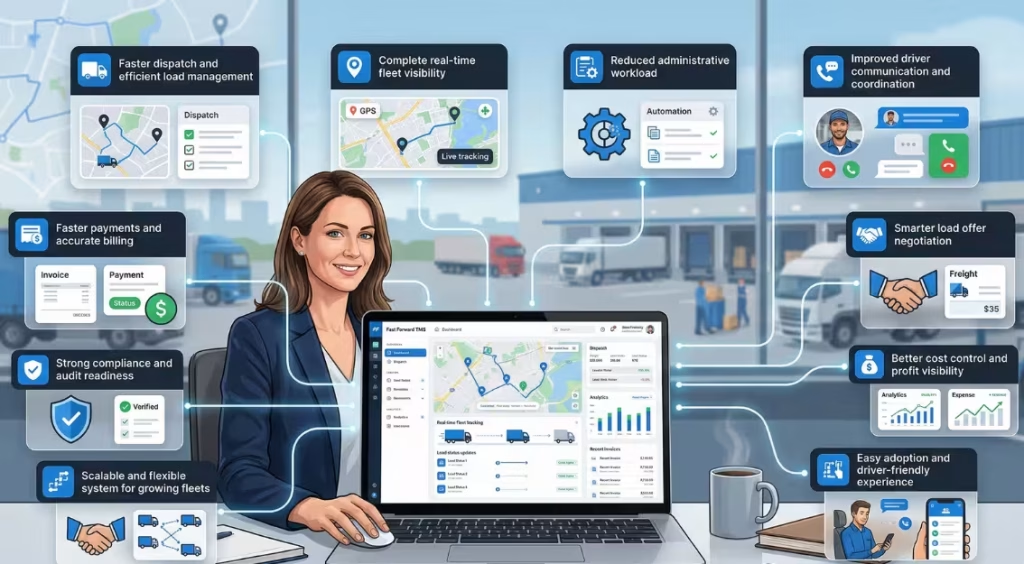
INTRODUCTION  10 Reasons Carriers Switch to Fast Forward TMS reflect the shift in modern trucking operations. Running a trucking business today is no longer just about moving freight from point A to point B. Carriers face ongoing challenges such as delayed dispatch, rising fuel costs, communication gaps, compliance pressure, and slow payment cycles. Many fleets still rely on spreadsheets and disconnected tools, which create inefficiencies, increase errors, and limit visibility. Without a centralized system, tracking trucks managing drivers, and making timely decisions becomes difficult—often leading to higher empty miles and reduced efficiency. Industry reports show that digital systems can improve operational efficiency by 20–30% while reducing manual workload. As competition grows, carriers are actively looking for smarter and more reliable ways to manage operations. Understanding the carrier TMS software benefits is now essential. A modern transportation management system helps streamline workflows, improve visibility, and automate key processes within a single platform. Fast Forward TMS is built to solve these challenges, backed by 18+ years of transportation technology expertise and trusted by 1,500+ companies worldwide. It helps carriers reduce inefficiencies, control costs, and gain complete operational visibility. Key Takeaways  You may also like to Read: How Fast Forward TMS Stands Out as the Best Choice in Carrier TMS Software  What is Carrier TMS Software?  A Carrier TMS (Transportation Management System) is a cloud-based software that helps trucking companies manage dispatch, tracking, billing, driver communication, and compliance from a single platform.  Instead of relying on spreadsheets or disconnected tools, it centralizes operations, improves visibility, and streamlines daily workflows. This allows carriers to reduce manual work, minimize errors, and make faster, data-driven decisions.  For modern fleets, a TMS is not just a tool—it is essential for running efficient and scalable operations.  Who Should Use Carrier TMS Software?  Carrier TMS software is designed for trucking businesses that want to improve efficiency, reduce manual work, and gain better control over daily operations.  It is especially useful for small fleets managing dispatch manually, growing carriers facing delays and coordination issues, and mid-sized fleets handling multiple trucks, routes, and compliance requirements.  As operations expand, relying on spreadsheets and phone calls becomes difficult and error-prone. A carrier TMS helps streamline workflows, improve visibility, and simplify day-to-day management.  For any fleet looking to scale, reduce inefficiencies, and operate more efficiently, adopting a TMS becomes a practical necessity.   10 Key Reasons Carriers Are Switching to Fast Forward TMS  In today’s trucking industry, operational efficiency plays a critical role in profitability. Carriers that continue to rely on manual processes and disconnected tools often face delays, errors, and limited visibility across their operations.  Fast Forward TMS is built to address these challenges by simplifying workflows, improving coordination, and providing better control over daily operations. It helps carriers operate more efficiently and make faster, data-driven decisions.  Trusted by 1,500+ carriers, Fast Forward TMS has helped improve dispatch workflows, with 95% of users reporting smoother operations. It stands out by solving real-world challenges while delivering measurable improvements in efficiency, visibility, and profitability.  Here are the 10 key reasons carriers are making the switch:  Faster Dispatch and Efficient Load Management  One of the biggest challenges in trucking operations is delayed or inefficient dispatch. When dispatchers rely on phone calls, spreadsheets, or manual coordination, assigning loads becomes slow and error-prone.  Fast Forward TMS simplifies this process by enabling real-time load assignment and driver availability tracking. Dispatchers can instantly identify which driver is available, assign loads quickly, and manage multiple shipments from a centralized dashboard.  This leads to faster turnaround times, better load utilization, and increased daily productivity. As a result, fleets can handle more loads without increasing operational complexity.  Complete Real-Time Fleet Visibility  Lack of visibility is one of the most common operational problems for carriers. Without real-time data, it becomes difficult to track shipments, monitor driver activity, or respond quickly to delays.  Fast Forward TMS provides live GPS tracking and centralized dashboards that give carriers full visibility into their fleet. Dispatchers can see where every truck is, track delivery progress, and make informed decisions instantly.  This level of visibility reduces uncertainty, improves customer communication, and helps prevent costly delays or missed deliveries.  Reduced Administrative Workload  Manual processes such as paperwork, data entry, and reporting consume a significant amount of time and increase the risk of errors.  Fast Forward TMS automates routine operational tasks, including documentation, reporting, and workflow management. This reduces the administrative burden on teams and minimizes human errors.  By eliminating repetitive tasks, carriers can focus more on core operations like load planning and fleet optimization, ultimately improving overall efficiency.  Improved Driver Communication and Coordination  Effective communication between dispatchers and drivers is essential for smooth operations. However, relying on constant phone calls often leads to miscommunication, delays, and inefficiencies.  Fast Forward TMS includes a built-in driver mobile app that enables real-time communication, instant updates, and document sharing. Drivers can receive load details, upload documents, and stay connected without unnecessary back-and-forth calls.  This improves coordination, reduces confusion, and enhances the overall driver experience.  Faster Payments and Accurate Billing  Delayed payments and billing errors are common challenges in trucking, especially when invoicing is handled manually.  Fast Forward TMS automates invoicing and settlement processes, ensuring that invoices are generated quickly and accurately. This reduces disputes, eliminates errors, and speeds up payment cycles.  With faster and more reliable billing, carriers can improve cash flow and maintain financial stability.  Smarter Load Offer Negotiation  Negotiating load rates has traditionally been a time-consuming process involving multiple phone calls and back-and-forth communication.  Fast Forward TMS introduces a built-in load offer negotiation system that allows dispatchers and drivers to share offers, counteroffers, and finalize rates instantly.  This reduces delays, improves transparency, and ensures faster decision-making. It also builds better trust between drivers and dispatchers, leading to stronger working relationships.  Strong Compliance and Audit Readiness  Compliance requirements such as IFTA reporting, HOS tracking, and documentation management are becoming increasingly complex.  Managing these processes manually not only increases workload but also raises the risk of errors and penalties.  Fast Forward TMS automates compliance-related tasks, ensuring accurate reporting and proper documentation. This helps carriers stay audit-ready while reducing the risk of costly fines.  Better Cost Control and Profit Visibility  Without proper data, many

Top 10 Reasons Carriers Switch to Fast Forward TMS  Read More »

Fast Forward TMS vs Spreadsheets: True Cost Comparison for Trucking Companies 

Fast Forward TMS vs Spreadsheets: True Cost Comparison for Trucking Companies 

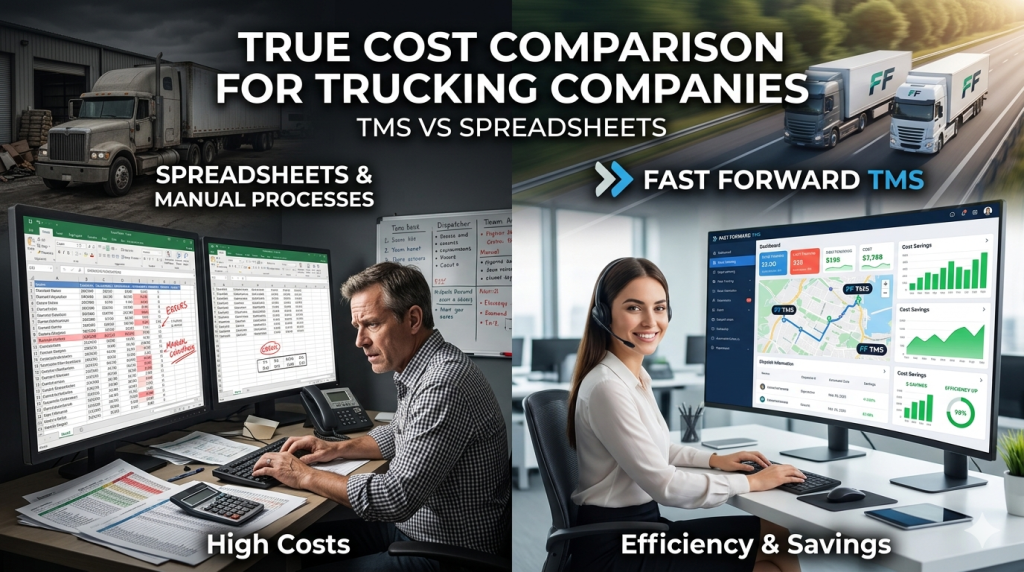
Introduction Running a trucking business today depends on how efficiently dispatch, tracking, billing, and compliance are managed. Yet many carriers still rely on spreadsheets for these critical operations. When comparing TMS vs spreadsheets, the difference is not just about cost—it’s about operational efficiency. Spreadsheets may seem affordable upfront, but as operations grow, manual workflows increase time, errors, and inefficiencies. Manual data entry, disconnected files, and repeated updates slow down processes. This leads to higher workload, delayed invoicing, limited visibility, and inconsistent cash flow. In contrast, carrier TMS software connects dispatch, tracking, billing, and compliance into one system. It reduces manual effort, improves accuracy, and provides real-time visibility across operations. In fact, at Fast Forward TMS, 95% of carriers report smoother dispatch workflows after adopting the platform, highlighting the real-world impact of automation and connected systems. This guide is written by Nitin Shankar, a logistics technology expert with 18+ years of experience, ensuring practical insights based on real trucking operations and system implementation. The real difference between a TMS and spreadsheets lies in scalability and efficiency. While spreadsheets create hidden operational costs, a TMS helps carriers improve cash flow, reduce errors, and scale operations without increasing workload. Key Takeaways: TMS vs Spreadsheets A TMS is more efficient and scalable than spreadsheets for trucking operations. While spreadsheets appear low-cost, they create hidden operational costs through manual work, errors, and delayed billing. A modern carrier TMS software reduces inefficiencies, improves cash flow, and supports business growth. Quick Summary Spreadsheets = low upfront cost, high hidden costManual workflows increase time, errors, and operational complexity.TMS = predictable cost, higher efficiencyAutomates dispatch, tracking, billing, and compliance in one system.Billing and cash flow improve with TMSFaster invoicing reduces delays and improves revenue consistency.Operational visibility is limited in spreadsheetsA TMS provides real-time tracking and centralized data.Scalability is the biggest differenceSpreadsheets become harder to manage as operations grow, while a TMS supports growth without extra workload.Error reduction directly impacts profitabilityAutomated workflows minimize manual mistakes and revenue leakage. What Costs Are We Comparing in TMS vs Spreadsheets? When comparing TMS vs spreadsheets, focusing only on software pricing gives a misleading view. In trucking operations, cost is not just what you pay upfront—it’s how your system affects efficiency, revenue, and scalability over time.Spreadsheets appear inexpensive because they have little to no upfront cost. However, their real impact is operational. Manual processes introduce time delays, errors, and inefficiencies that gradually increase the total cost of running a trucking business.A modern carrier TMS software, on the other hand, introduces a predictable subscription cost but reduces hidden operational expenses through automation and connected workflows. Key Cost Factors in TMS vs Spreadsheets You may also like to Read: TMS Software vs Traditional Methods – A Complete Comparison for Fleet Management in 2025 Where Spreadsheets Actually Cost You in Trucking Operations At first glance, spreadsheets appear cost-effective because they require little to no upfront investment. However, in a TMS vs spreadsheets comparison, the real cost is not eliminated—it is distributed across daily operations through time loss, errors, and inefficiencies.As trucking operations grow, these hidden costs become more visible and begin to impact productivity, accuracy, and cash flow. Time Loss from Manual Workflows Time is the first and most immediate cost. Managing loads through spreadsheets requires continuous manual effort—data is entered repeatedly, updated across multiple files, and coordinated outside the system.As volume increases, this creates a growing administrative burden where teams spend more time managing data than executing operations. Errors That Disrupt Operations Spreadsheets rely entirely on manual input, making data accuracy difficult to maintain. Missing entries, duplicate records, broken formulas, and outdated information often lead to billing errors and operational confusion.These errors directly impact efficiency and increase the risk of financial loss. Revenue Leakage and Billing Delays Without a connected system, ensuring accurate and timely billing becomes challenging. Missed invoices, delayed billing cycles, and incomplete charges reduce revenue visibility and slow down cash flow.Over time, these gaps create significant financial impact. Limited Visibility and Slow Decision-Making Spreadsheets do not provide real-time tracking or centralized insights. Teams rely on manual updates and scattered information, making it harder to monitor performance or respond quickly to operational issues.This lack of visibility slows decision-making and reduces overall control. Compounding Inefficiencies as You Scale As more loads, drivers, and transactions are added, spreadsheet-based workflows become increasingly complex. Instead of improving efficiency, growth leads to more coordination, more manual effort, and higher operational risk.In a TMS vs spreadsheets scenario, this is where spreadsheets shift from a simple tool to a limitation on scalability. You may also like to Read: Top 5 Ways a TMS Software Reduces Manual Work for Dispatchers  How Fast Forward TMS Reduces Operational Costs In a TMS vs spreadsheets comparison, the biggest advantage of a modern system is automation. Unlike spreadsheets, carrier TMS software like Fast Forward TMS manages trucking operations through connected workflows, reducing the operational cost created by manual processes.By bringing dispatch, tracking, billing, and compliance into one system, it eliminates the need for repetitive coordination and disconnected tools. Faster Operations with Less Manual Work Time efficiency improves immediately. Tasks like data entry, load updates, and coordination no longer require repeated manual effort.Information is entered once and automatically flows across workflows, reducing duplication and administrative workload. This allows teams to focus on operations instead of managing data. Improved Accuracy and Fewer Errors Structured workflows and system-driven processes improve data accuracy.Duplicate entries, missing records, and billing errors are significantly reduced, resulting in smoother operations and fewer disruptions. Faster Billing and Stronger Cash Flow Billing becomes faster and more reliable because it is directly connected to operational data.Invoices can be generated immediately after load completion, while integrated driver payroll ensures timely payments. This reduces delays and improves overall cash flow consistency. Scalable Operations Without Extra Workload As operations grow, the system handles increased complexity without adding manual effort.More loads, drivers, and transactions can be managed within the same workflow. Integrated truck tracking software provides real-time visibility, helping teams make faster and more informed decisions. Simplified Compliance and Record

Fast Forward TMS vs Spreadsheets: True Cost Comparison for Trucking Companies  Read More »

Top Reasons Fleet Owners Struggle With Driver Retention in Trucking (And How to Improve It) 

Top Reasons Fleet Owners Struggle With Driver Retention in Trucking (And How to Improve It) 

Driver retention in trucking has become one of the biggest challenges for fleet owners today. While many trucking companies invest heavily in recruiting new drivers, retaining experienced drivers for the long term remains difficult. Operational stress, poor communication, unpredictable schedules, and administrative burdens often lead drivers to seek better opportunities with other carriers.  High driver turnover creates both financial and operational pressure for fleets. Companies must repeatedly invest in recruiting, onboarding, and training new drivers, while trucks may sit idle and delivery schedules can be disrupted when experienced drivers leave.  Industry reports indicate that driver turnover rates in large trucking fleets can exceed 90% annually, making retention a major priority for fleet managers. Improving driver retention in trucking requires better communication, organized dispatch operations, and more driver-friendly workflows.  By addressing the operational challenges drivers face daily, fleets can build a more stable workforce, improve driver satisfaction, and maintain consistent fleet performance.  Key Takeaways  Why Driver Retention in Trucking Is a Growing Challenge  Driver retention in trucking has become increasingly difficult across the transportation industry. Many fleets face driver shortages, rising operational pressure, and strong competition among carriers. Because experienced drivers often have multiple job opportunities, they are more likely to switch companies when working conditions are not ideal.  Long driving hours, tight delivery schedules, and extended time away from home can also affect driver satisfaction. When drivers feel overworked or unsupported, they may look for fleets that offer better communication, predictable schedules, and more organized operations.  Operational efficiency also plays an important role in retention. Drivers prefer companies where dispatch instructions are clear, schedules are stable, and administrative tasks are minimized. Improving these operational systems helps fleets strengthen driver retention and maintain a more stable driver workforce.  The Real Cost of Poor Driver Retention for Fleet Owners  Poor driver retention in trucking creates significant financial and operational challenges for fleet owners. When drivers frequently leave, companies must continuously invest in recruiting, background checks, onboarding, and training programs. These repeated hiring cycles increase operating costs and consume valuable management time.  High turnover also affects productivity. When a driver leaves, trucks may remain idle until a replacement is hired and trained. This downtime directly impacts revenue and can disrupt delivery schedules, making it harder for fleets to maintain consistent operations.  Customer relationships can also suffer when turnover rates are high. New drivers often need time to learn routes, procedures, and company expectations, which can lead to service delays or inconsistencies.  By improving communication, streamlining workflows, and supporting drivers more effectively, fleets can reduce turnover and strengthen driver retention while maintaining stable and reliable operations.  Top Reasons Fleet Owners Struggle With Driver Retention  Many fleet owners understand the importance of driver retention in trucking, yet keeping experienced drivers for the long term remains challenging. In most cases, the issue is not caused by a single problem but by multiple operational factors that affect a driver’s daily work experience.  Drivers expect clear communication, organized dispatching, predictable schedules, and transparent payment processes. When these expectations are not met, frustration can quickly build. Over time, this dissatisfaction encourages drivers to search for fleets that offer better support and smoother operations.  Operational inefficiencies are often a hidden cause of poor driver retention. Confusing dispatch instructions, slow paperwork processing, inconsistent settlements, and lack of transparency can make a driver’s job unnecessarily difficult.  To improve driver retention in trucking, fleet owners must identify and address the everyday challenges drivers face. The following sections highlight the most common reasons drivers leave fleets and how companies can solve these problems.  Poor Communication Between Drivers and Dispatch  One of the most common reasons fleets struggle with driver retention in trucking is poor communication between drivers and dispatch teams. Drivers rely on dispatchers for load details, route updates, delivery schedules, and operational guidance. When communication is unclear or delayed, it creates confusion and unnecessary stress during daily operations.  Drivers often experience issues such as last-minute load changes, unclear instructions, or difficulty reaching dispatch when problems occur on the road. These communication gaps can make drivers feel unsupported and frustrated.  Clear and timely communication helps drivers perform their jobs with confidence. When fleets provide organized dispatch coordination, quick responses, and transparent updates, drivers feel more informed and respected. Improving communication between drivers and dispatch teams is therefore a key step toward strengthening driver retention in trucking.  Inefficient Dispatch and Scheduling  Inefficient dispatch processes are another major factor affecting driver retention in trucking. When load assignments are poorly organized or schedules frequently change, drivers experience delays and unnecessary frustration. These disruptions make it difficult for drivers to plan routes, manage rest periods, and maintain a predictable work routine.  Many fleets still rely on manual scheduling methods such as spreadsheets or phone-based coordination. This approach often leads to missed updates, overlapping assignments, and last-minute route adjustments. As a result, drivers may spend more time waiting for instructions instead of moving freight efficiently.  Organized dispatch planning and consistent scheduling help drivers work more efficiently and with less stress. When fleets improve dispatch coordination and reduce operational confusion, they can significantly strengthen driver retention and maintain a more reliable driver workforce.  Lack of Driver Support Technology  A lack of modern technology can also negatively impact driver retention in trucking. Many drivers still deal with manual paperwork, phone-based updates, and slow administrative processes during daily operations. These outdated systems make routine tasks more complicated and time-consuming.  Today’s drivers expect tools that simplify their work on the road. Mobile apps, digital document uploads, and real-time load updates can help drivers manage tasks more efficiently. When fleets fail to provide these tools, drivers may feel that the company is not keeping up with industry standards.  Modern technology also improves transparency and reduces errors. When drivers receive timely updates and can submit documents digitally, their daily workflow becomes smoother. Fleets that invest in driver-support technology often experience stronger driver retention because drivers can focus more on driving and less on administrative work.   Unpredictable Pay and Slow Settlements  Compensation plays an important role in driver retention in trucking. While pay levels matter, consistency and transparency in payments are equally important for drivers. When settlements are delayed or payment calculations are unclear, drivers may quickly lose trust in fleet operations.  Many drivers rely on regular settlements to manage their personal finances while working on the road. If payroll processing takes

Top Reasons Fleet Owners Struggle With Driver Retention in Trucking (And How to Improve It)  Read More »

Scroll to Top