
Introduction
Imagine a small trucking fleet drowning in paperwork, juggling endless phone calls with drivers, and missing delivery updates. Every delay impacts profits, every mistake affects customer trust, and every manual process slows growth.
According to the study of Conqueror Network, In 2025 small and medium carriers face rising fuel costs, stricter compliance rules, and growing customer demands for real-time shipment tracking. Without a TMS for Carriers, these challenges can quickly overwhelm traditional operations.
Across the industry, fleets adopting TMS for Carriers are shifting from manual chaos to digital efficiency. The right Transport Management System (TMS) empowers carriers to streamline dispatch, automate documentation, improve communication, and reduce operational costs—making it easier to stay competitive in today’s fast-paced trucking landscape.
What is a TMS for Carriers?
A TMS for carriers is a software solution created to streamline and automate everyday trucking tasks, making fleet management faster, easier, and more accurate. Instead of juggling spreadsheets, paper logs, and phone calls, a TMS provides a centralized digital hub where carriers can manage dispatching, load assignments, invoicing, and real-time driver tracking all in one place.
For small and medium fleets, a TMS for Carriers reduces errors, speeds up billing cycles, and improves communication between dispatchers and drivers. By streamlining operations, carriers can cut operational costs, save time, and increase productivity, ensuring they stay competitive in the evolving freight industry.
Also Read – What Is a Transport Management System (TMS) and How Does It Work?
Why Carriers Need a TMS in 2025
In 2025, the trucking industry is more competitive and regulated than ever. Carriers still relying on spreadsheets, paper logs, and phone calls risk falling behind. Implementing a TMS for Carriers helps fleets tackle the industry’s biggest challenges:
- Digital Transformation: Customers and shippers demand real-time updates and full visibility. A TMS provides live shipment tracking, automated alerts, and improved communication, keeping carriers reliable and transparent.
- Rising Operational Costs: Fuel management and automated billing in a TMS for Carriers help control expenses, reduce empty miles, and save valuable resources.
Also Read – How a Transport Management System (TMS) Improves Fleet Productivity and Reduces Operating Costs - Compliance and Safety Requirements: HOS logs, safety reporting, and regulatory paperwork are automated, lowering the risk of fines and penalties.
- Meeting Customer Expectations: Timely and accurate deliveries strengthen client relationships and protect valuable contracts.
Overall, a TMS for Carriers ensures smarter freight management, fewer errors, and improved profitability, giving fleets the tools to remain competitive and efficient in a rapidly evolving market.
Top 10 Benefits of Implementing a TMS for Carriers in 2025
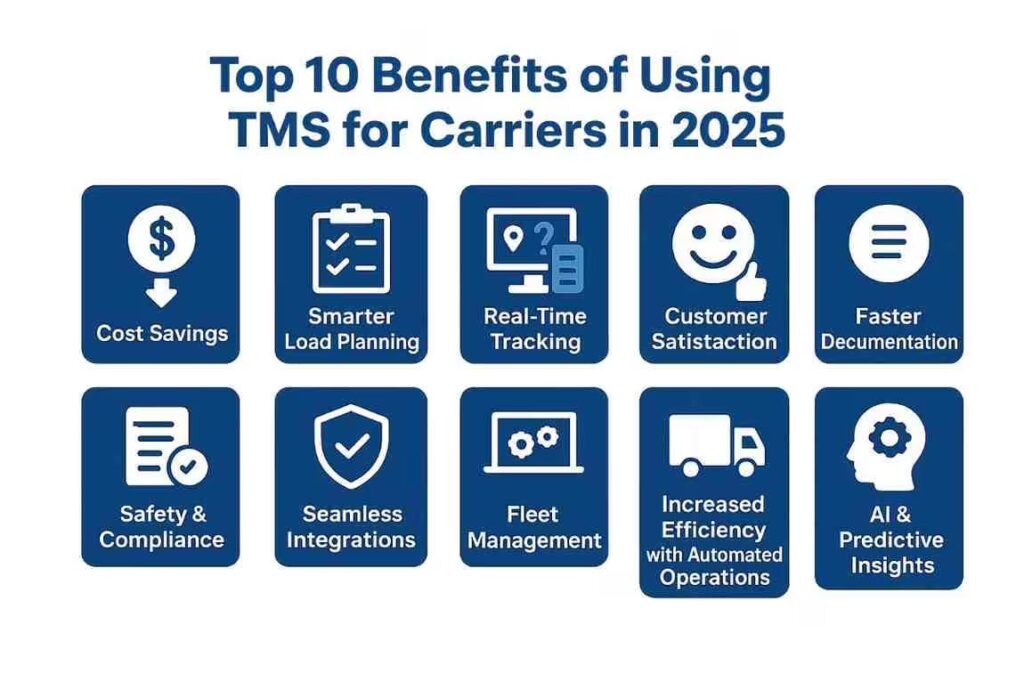
In today’s fast-paced trucking environment, TMS for Carriers is no longer optional—it’s essential. Manual processes such as spreadsheets, phone calls, and paper records can no longer meet the demands of higher fuel expenses, tighter regulatory requirements, and increasing customer expectations. A TMS for Carriers provides an end-to-end solution that optimizes resources, improves efficiency, and enhances service delivery. Here are the top 10 benefits in 2025:
1 – Reduced Transportation Costs with Smart Optimization
TMS for carriers minimizes operational costs by cutting empty miles, optimizing fuel usage, and automating billing. Advanced routing ensures trucks run on the most efficient paths, saving both money and time.
Examples of Cost Savings:
- Automated billing and freight auditing reduce manual work and prevent costly errors.
- Fuel management tools help track consumption and control rising fuel expenses.
- Load management features allow smarter freight handling, lowering overall costs.
2 – Smarter Load Planning and Resource Utilization
Carriers often lose revenue due to underutilized trucks. A TMS ensures that vehicles are matched to the right loads in real time, maximizing fleet usage and driver schedules.
Feature Highlight: Load Planning & Optimization assigns trips automatically based on truck capacity, availability, and delivery deadlines—ensuring no mile goes wasted.
3 – Real-Time Shipment Tracking and Analytics
Modern TMS trucking software provides real-time visibility into shipment status, driver location, and delivery progress. This level of insight helps fleets avoid delays, make faster decisions, and keep customers informed.
Impact on Customer Service:
- Automated ETA notifications improve communication.
- Live dashboards help managers resolve bottlenecks instantly.
- Predictive insights reduce late deliveries.
4 – Stronger Customer Satisfaction with Transparent Deliveries
In logistics, trust is everything.With a TMS for carriers, fleets can provide instant shipment updates, precise delivery times, and digital proof of delivery. This transparency enhances trust, improves client satisfaction, and fosters long-term partnerships.
Example in Action: Carriers using Customer Portal & Automated Notifications report fewer support calls, improved transparency, and stronger repeat business.
5 – Simplified Documentation and Faster Cash Flow
Paperwork delays cash flow and adds unnecessary complexity. A TMS for carriers digitizes key documents like bills of lading, PODs, and invoices—reducing errors and accelerating payment cycles.
Feature Highlight: Digital Documentation & eBOLs eliminate duplicate records and create a faster, error-free billing process.
6 – Safety and Compliance Made Simple
Compliance with HOS, driver logs, and safety reports is critical for avoiding fines and maintaining contracts. A carrier TMS automates these checks, ensuring fleets stay compliant without drowning in paperwork.
Compliance Benefits:
- Automated driver log updates.
- Digital compliance reporting for faster audits.
- Reduced risk of penalties and violations.
7 – Seamless Integrations with Other Tools
The best TMS for carriers integrates with GPS systems, accounting platforms, and even freight broker TMS software. This creates one connected workflow where every system talks to each other—no silos, no delays.
Feature Highlight: API & Third-Party Integrations enable carriers to connect all operational tools in one hub.
8 – Smarter Fleet and Asset Management
Every year, carriers face significant financial losses due to avoidable vehicle breakdowns and unscheduled downtime. A TMS ensures proactive maintenance, extended asset life, and maximum truck availability.
Example in Action: Fleets using Fleet & Asset Tracking reduce breakdowns, cut repair costs, and keep more trucks road-ready.
9 – Increased Efficiency with Automated Operations
Manual processes like dispatching, payroll, and load matching slow down growth. A TMS for carriers automates these workflows, freeing up staff to focus on business expansion.
Feature Highlight: Automated Dispatch & Driver Communication ensures every load is assigned and tracked with minimal human input.
10 – Future-Ready with AI and Predictive Analytics
As logistics becomes more digital, carriers using AI-powered TMS gain a competitive edge. Predictive analytics forecast delays, recommend routes, and identify cost-saving opportunities before they happen.
Impact on Growth:
- AI-driven route optimization improves delivery speed.
- Predictive maintenance reduces downtime.
- Smarter automation keeps carriers ahead of industry shifts.
Also Read – Five Ways AI Is Transforming the Trucking Industry in 2025
How to Choose the Best TMS for Carriers
Choosing the right TMS for Carriers is critical for improving efficiency, reducing errors, and supporting fleet growth. The ideal solution balances simplicity, reliability, and scalability. Key factors to consider include:
- Ease of Use – The platform should be intuitive for both dispatchers and drivers, reducing manual errors and speeding up daily operations.
- Strong Support – Easy Onboarding, training, and dedicated customer service ensure smooth adoption and long-term success.
- Seamless Integrations – Connect payroll, fuel management, compliance tools, and driver mobile apps to maintain a unified workflow.
- Scalability – Affordable for small fleets, yet robust enough to support growing operations with advanced tools like Load Offer Negotiation and Driver Availability & Smart Geo-Location Matching.
These features make a TMS for carriers a trusted choice in 2025, providing a powerful, easy-to-use, and future-ready system that supports fleet growth and operational efficiency.
Also Read – Top 10 Features of Trucking Management System Software: TMS Features Explained
Why Fast Forward TMS is the Best TMS for Carriers in 2025
Fast Forward TMS, built on 18+ years of industry expertise and 7+ years of product development, powers 1,500+ carriers with easy-to-use, affordable, and scalable tools. Features like Load Offer Negotiation, Smart Geo-Location Matching, GPS tracking, ePOD, and payroll automation boost efficiency and compliance. With SOC 2 Type 2 security, strong support, 95% smoother dispatch workflows, and the first truck free, it’s the most trusted, accessible TMS for carriers in 2025.
Also Read – Best Carrier TMS Software for Trucking in 2025: How to Choose the Right Solution
Final Thoughts: The Future of TMS for Carriers in 2025
The trucking industry is rapidly shifting from manual processes like paperwork and phone calls to Digital TMS solutions. For carriers, adopting a TMS for carriers is essential to remain competitive, reduce operational costs, and ensure timely deliveries. Fleets leveraging digital tools can improve efficiency, streamline compliance, and meet customer expectations more effectively.
Around the world, small and mid-sized carriers are proving that a TMS drives higher profitability, better driver satisfaction, and stronger customer trust. The future of trucking belongs to fleets that embrace technology today.
Take the next step by exploring a reliable TMS for carriers and start your journey toward smarter, more efficient operations.
FAQ’s
1. What is a TMS for carriers, and how does it work?
A TMS for carriers is software that automates dispatching, load planning, invoicing, and driver tracking, centralizing operations and reducing errors.
2. How does a TMS help reduce transportation costs?
It lowers costs by consolidating loads, automating billing, and tracking fuel usage, minimizing empty miles and overhead.
3. What features should a carrier look for in a TMS?
Essential features include load management system, eBOLs, Driver Availability & Smart Geo-Location Matching, real-time tracking, automated dispatch, and compliance tools.
4. Can a TMS improve customer satisfaction?
Yes. Real-time updates, automated ETAs, and proof of delivery enhance transparency and trust with clients.
5. Can Small and Mid-Sized Carriers Benefit from a TMS?
Yes. Scalable and easy-to-use TMS solutions help smaller carriers improve efficiency, payments, and growth readiness.